Validation Services
Empty vs Loaded Chamber Mapping: Why Both Studies Matter
Author: KevinStrickland
Sep 10, 2026
A chamber can pass its qualification empty and still put product at risk once it is full. It can also pass loaded and leave you with no baseline to explain what went wrong later.
On the surface, one study looks like enough. In practice, an empty chamber and a loaded chamber behave differently, and each one answers a different question.
In pharmaceutical, biotech, healthcare, blood banking, and tissue banking environments, that difference matters. Product does not sit in an empty box, but is packed on shelves, in totes, and in configurations that change how heat and air move.
That is why a well-designed temperature mapping study may call for both conditions.
What an Empty Chamber Study Tells You
An empty chamber study characterizes the equipment itself.
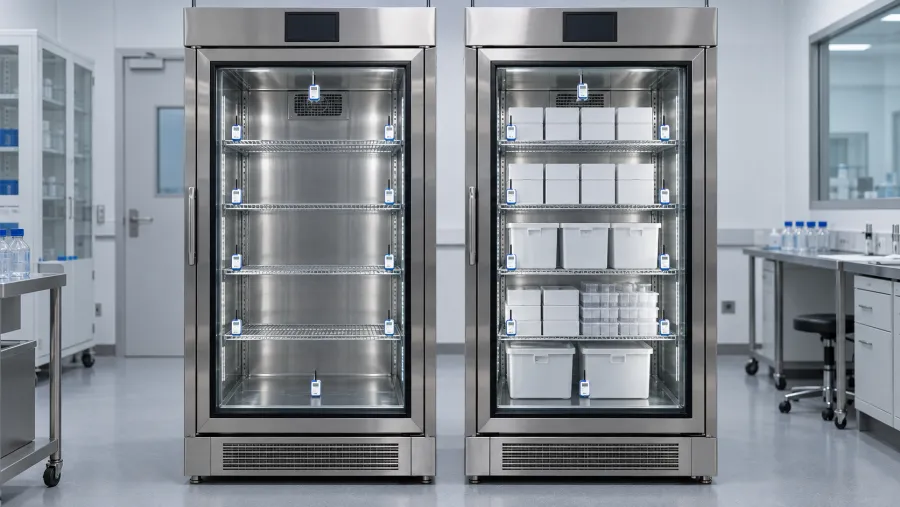
With no product inside, calibrated data loggers show how the chamber performs on its own: how well it holds setpoint, how uniform it is corner to corner, and how it recovers after a door opening or a power interruption.
An empty study can help answer:
- Is the equipment capable of holding the required range?
- How uniform is the chamber before product is introduced?
- Where are the warmest and coldest locations by design?
- How does the unit recover after a disturbance?
- Is the control probe reading representative of the space?
This is the cleanest look you will get at the equipment. Nothing is absorbing heat, blocking airflow, or holding cold. What you see is the chamber's own behavior, which makes it the right baseline for judging whether the unit is fundamentally fit for use.
What a Loaded Chamber Study Tells You
A loaded chamber study characterizes reality.
Product changes everything about how a chamber behaves. It adds thermal mass, blocks airflow, and creates its own hot and cold pockets. A unit that perfectly passed the empty chamber validation can develop a warm zone once a shelf is packed tight enough to choke air movement.
A loaded study can help answer:
- Does the chamber still hold range with product inside?
- Did loading create new hot spots or cold spots?
- How does a full chamber recover after a door opening?
- Are all storage locations still acceptable when the unit is in real use?
- Does thermal mass help stability, hurt it, or both?
Thermal mass is worth calling out. A full chamber often handles short door openings and brief excursions better than an empty one because the product itself resists change. However, that same mass can slow recovery and hide airflow problems. Only a loaded study shows how those forces balance during daily use.
Why One Study Is Not Enough
It is tempting to run one study and move on. The problem is that each study leaves a blind spot the other one covers.
Run only an empty study, and you have qualified the box, but not the way you use it. You have no data on how your loading pattern affects distribution, and no evidence that a packed chamber stays in range.
Run only a loaded study, and you have no clean baseline. When performance drifts later, you cannot separate an equipment problem from a loading problem because you never measured the equipment on its own.
Together, the two studies let you tell those causes apart:
The empty study isolates the equipment.
The loaded study captures real-world use.
The comparison shows exactly what product and loading did to usable space within the chamber.
That comparison is the point and when combined gives users a more complete picture of how the chamber functions.
How the Two Studies Work Together
When used together, the two studies give both halves of a full picture.
The empty study sets the baseline and confirms the equipment is capable. The loaded study confirms the chamber still performs the way the product requires once it is in service. Read side by side, they show whether any variation comes from the unit or from how it is loaded, and they inform where monitoring probes should sit for day-to-day operation.
The findings can also inform a stronger continuous environmental monitoring strategy by helping teams select representative monitoring locations.
When Both Studies Should Be Considered
Running both an empty and a loaded study is often appropriate when a new chamber, refrigerator, freezer, incubator, stability chamber, or cold room is being qualified for use.
Both may also be warranted when something changes or when a risk-based CQV strategy calls for requalification. Examples include:
- Equipment relocation
- Repairs or modifications
- Changes to shelving or internal configuration
- Significant changes in loading pattern or product volume
- Changes to operating parameters
- Unexplained temperature variability
- New product or storage requirements
- Periodic requalification based on internal procedures or risk assessment
There is no single schedule that fits every organization. The right approach depends on the equipment, the product, the loading configuration, the quality system, and applicable requirements.
What a Good Empty and Loaded Study Includes
Running both studies well requires more than mapping the unit twice.
It should start with a defined protocol that identifies the equipment, the empty and loaded conditions, the loading configuration, study duration, logger locations, acceptance criteria, and reporting expectations. The loading configuration matters as much as logger placement because a loaded study is meaningful only when the load reflects a defined operating or worst-case condition. The protocol should document why the selected load is representative and how the results will be applied.
Loggers should be placed to characterize the space in both conditions, including shelves, heights, corners, doors, return-air locations, and areas where variation is more likely. Where possible, keeping logger positions consistent between the two studies makes the comparison cleaner.
A good report should help answer:
- Did the chamber meet acceptance criteria empty and loaded?
- Where were the warmest and coldest points in each condition?
- What did loading change?
- Did the data support the intended use and loading pattern?
- What should the organization consider for monitoring, storage, or follow-up?
Why This Matters
Temperature-sensitive products have defined storage requirements for a reason. Exposure to unsuitable conditions may raise concerns about quality, stability, efficacy, or suitability for use.
An empty study alone can leave you confident in a chamber that struggles under load. A loaded study alone can make it harder to separate equipment performance from loading effects. Together, the studies give quality, validation, laboratory, pharmacy, blood bank, tissue bank, and facilities teams a more complete picture of chamber performance and provide documented data for review during an audit or investigation.
A passing empty study is useful. A passing loaded study is important. But neither one, by itself, tells the full story.
Empty and Loaded Chamber Studies from Rees Scientific
Rees Scientific provides temperature and humidity mapping services for regulated and temperature-sensitive environments, including pharmaceutical, biotechnology, healthcare, life science, blood banking, tissue banking, and research applications.
Rees performs both empty and loaded chamber studies using calibrated data loggers placed throughout the space. The studies help identify hot spots, cold spots, recovery behavior, and the effect of loading, so organizations understand how a chamber performs before and after product is introduced.
Customers receive documented reporting, including data analysis, that makes the difference between empty and loaded performance easier to understand.
Frequently Asked Questions
What is the difference between an empty and a loaded chamber study?
An empty chamber study characterizes the equipment on its own, with no product inside. A loaded chamber study characterizes the chamber in real use, with product in place. The empty study establishes a baseline, and the loaded study shows how loading affects temperature distribution.
Why do I need both?
Each study answers a question the other cannot. The empty study confirms the equipment is capable and provides a clean baseline. The loaded study confirms the chamber still performs with product inside. Running both lets you tell an equipment problem apart from a loading problem later.
Does a loaded chamber perform better or worse than an empty one?
It depends. Thermal mass from product can help a full chamber’s temperature specifications survive short door openings and brief excursions, but it can also slow recovery and create new hot or cold spots by blocking airflow. A loaded study shows how those effects balance your specific product and loading conditions.
When should both studies be performed?
Both are often appropriate during initial qualification, and may be warranted after relocation, repairs, changes to shelving or loading, changes to operating parameters, or during periodic requalification.
What types of equipment can be studied this way?
Rees Scientific performs empty and loaded studies on refrigerators, freezers, CTUs, incubators, stability chambers, cold rooms, and other controlled environments. Generally any type of equipment that is designed to hold a specific temperature range can be studied this way.
See the Full Picture: Empty and Loaded
An empty study tells you what the equipment can do. A loaded study tells you what it does with your product inside. You need both to know your chamber.
Rees Scientific can help organizations run empty and loaded chamber studies, identify hot and cold spots in each condition, evaluate the effect of loading, and document results in a way that supports product protection, quality decisions, and audit readiness.
Request a Mapping and Validation Assessment