Validation Services
Cleanroom Commissioning: What It Really Takes to Get It Right
Author: Gagan Kaur
Mar 20, 2026
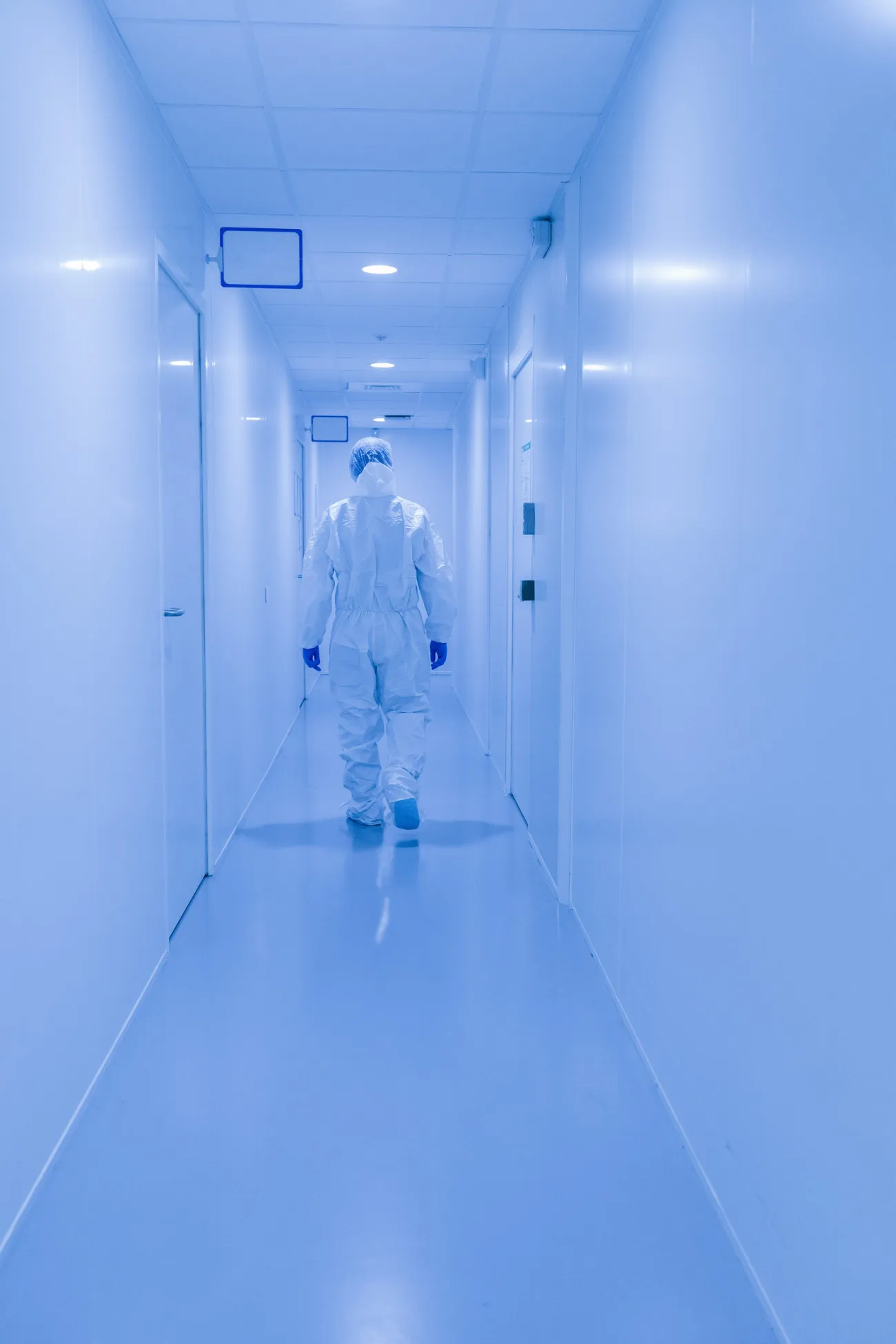
When a cleanroom comes online, it's easy to focus on the build. The walls, the airflow design, the finishes. But the real test starts after construction is complete.
Commissioning and qualification are where a cleanroom proves it can perform the way it was intended to. For teams in pharma, biotech, and advanced therapies, this isn't just a checkbox. It's the difference between a controlled environment and one that quietly introduces risk.
Why Cleanroom Commissioning Matters More Than Ever
Cleanrooms are becoming more critical and more complex at the same time.
Cell and gene therapy manufacturing continues to expand, with many processes requiring tightly controlled ISO 5 to ISO 7 environments. At the same time, regulatory expectations are evolving, especially with updates like EU GMP Annex 1 placing greater emphasis on contamination control strategies and continuous monitoring.
Facilities are also being brought online faster than ever. That combination creates pressure. Teams need to move quickly, but they can't afford gaps in performance. Commissioning bridges that gap. It answers a simple but important question:
Does this cleanroom actually behave the way it was designed to?
What Cleanroom Qualification Actually Involves
The cleanroom commissioning process includes a series of tests, including airflow testing, environmental verification, and system qualification activities.
Cleanroom Airflow & Pressure: The Foundation of Control
Everything in a cleanroom starts with airflow. You're not just moving air, you're controlling contamination pathways.
Key activities include:
- Total Air Balance (TAB) and Air Changes Per Hour (ACPH) verification
- Unidirectional airflow velocity testing
- Airflow visualization through smoke studies
- Differential pressure testing and pressure cascade verification
- HEPA/ULPA filter integrity testing (DOP/PAO)
This is often where the first real insights emerge. A system may meet design specs on paper, but smoke studies can reveal turbulence, dead zones, or unexpected flow patterns that impact performance.
Cleanroom Environmental Monitoring: Understanding the Space Over Time
A cleanroom isn't static. Conditions shift throughout the day based on personnel, equipment, and process activity. That's why qualification goes beyond a single snapshot.
- Temperature and humidity trending and mapping
- Viable and non-viable particulate monitoring
- Microbial air sampling (active and passive)
- Surface microbial sampling
- Particle count testing at rest and in operation
The goal is to build a complete picture of how the room behaves, not just confirm a single point in time.
Room Performance: How the Cleanroom Responds
Even a well-designed cleanroom needs to prove it can recover and maintain control under real conditions. Performance testing focuses on how the space reacts:
- Recovery testing (clean-down time)
- Containment and leakage testing
- Room pressurization alarm verification
- Lighting level verification (lux)
- Noise level verification (dB)
- Vibration testing, where applicable
These tests highlight how the cleanroom performs during actual use, not just ideal conditions.
Supporting Systems: The Backbone Behind the Cleanroom
Cleanroom performance depends heavily on supporting infrastructure:
- HVAC and AHU qualification (IQ/OQ/PQ)
- Building Management System (BMS) and Environmental Monitoring System (EMS) alarm verification
- Gowning room qualification
- Personnel and material airlock qualification
- Pass-through and autoclave qualification
If these systems aren't aligned, the cleanroom won't operate consistently, even if initial testing looks successful.
Documentation & Compliance: Proving It All Works
Every aspect of commissioning needs to be documented and aligned with regulatory expectations:
- ISO 14644-1/2 classification testing
- GMP classification verification (EU Annex 1 Grades A–D or FDA expectations)
- Risk assessments and User Requirement Specifications (URS)
- Cleaning and disinfection validation
- Change control and requalification triggers
This creates a defensible record of how the cleanroom was qualified and how it will be maintained over time.
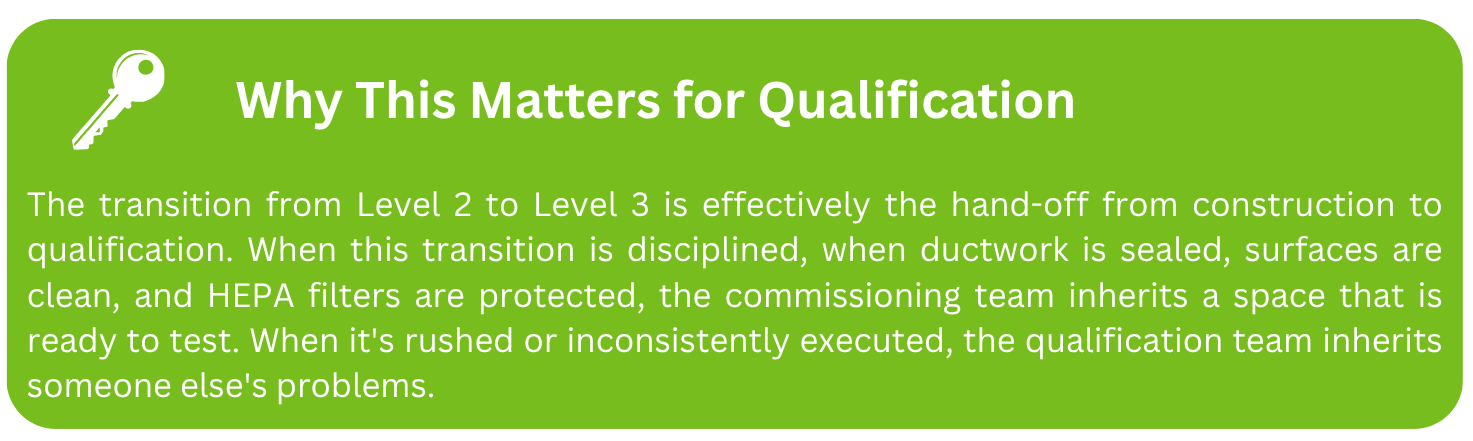
The Clean Build Mindset: Commissioning Starts at Construction
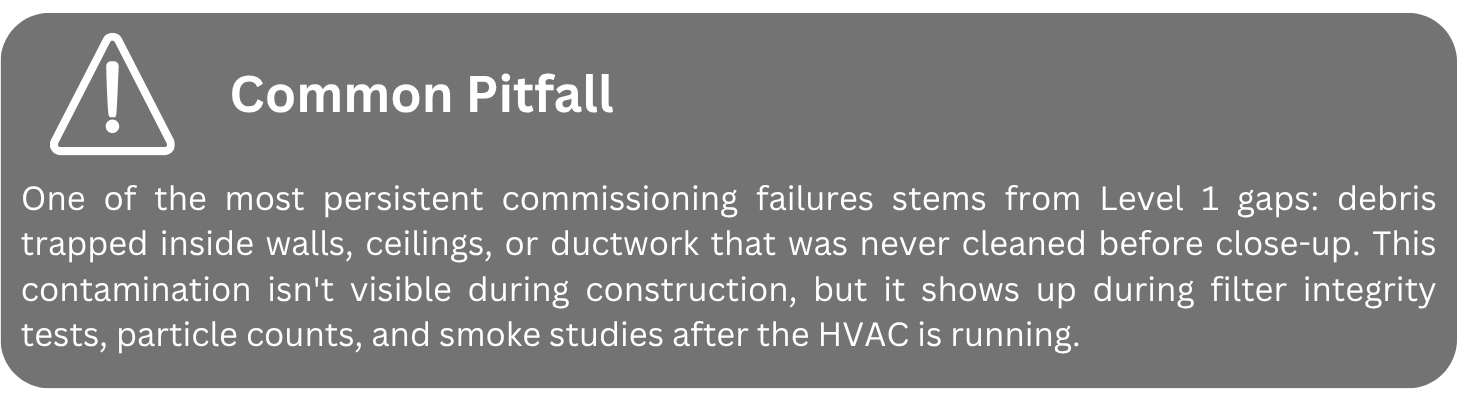
One of the most underappreciated aspects of cleanroom commissioning is how early the process really begins. Qualification activities at the end of a project are directly shaped by decisions made during construction. A contamination event traced to debris trapped in a wall cavity or a poorly sealed conduit penetration can cascade into failed testing, rework, and schedule delays.
Industry-standard Clean Build Protocols, like those used on major pharmaceutical construction projects, establish a tiered system of cleanliness requirements that escalate as the facility takes shape. Understanding this framework helps quality and validation teams set realistic expectations and intervene early when needed.
Three Levels of Clean Build Control
Level 1: Isolation and Containment
This phase begins once the building envelope is closed: foundation poured, exterior walls up, roof complete, windows and doors installed. The classified areas are defined but not yet built out.
Key requirements during this phase:
- All electrical boxes, conduits, and wall/ceiling penetrations must be sealed to prevent pressure loss and air leakage.
- Raw metals (galvanized, copper, steel) must be coated with approved urethane or epoxy and painted outside the classified area before installation.
- HEPA vacuums are required to remove drywall dust from structural members and ductwork.
- Every trade is responsible for continuous daily cleanup, trapping debris inside walls or ceilings is a qualification risk, not just a housekeeping issue.
- Piping must be kept clean and sealed during storage and assembly to prevent contamination introduction.
Level 2: Classified Area Construction Rough-In
By Level 2, fire sprinkler lines and plenum hangers are installed, the interior has been painted and sealed, and the rough-in of mechanical, electrical, piping, and controls systems is underway.
Additional requirements that layer onto Level 1 controls:
- All materials must be unpacked and uncrated outside classified areas.
- Tools and materials must be visually inspected and cleaned of grease, oil, dirt, and debris before entry.
- Cutting machines must be staged outside classified areas, no cutting inside.
- All ductwork and clean piping must be cleaned, sealed before shipment, and opened only as needed during assembly. After each connection, reseal and visually inspect before proceeding.
- Dust-generating activities (drywall sanding, concrete cutting) must be coordinated and scheduled, not left to individual subcontractor discretion.
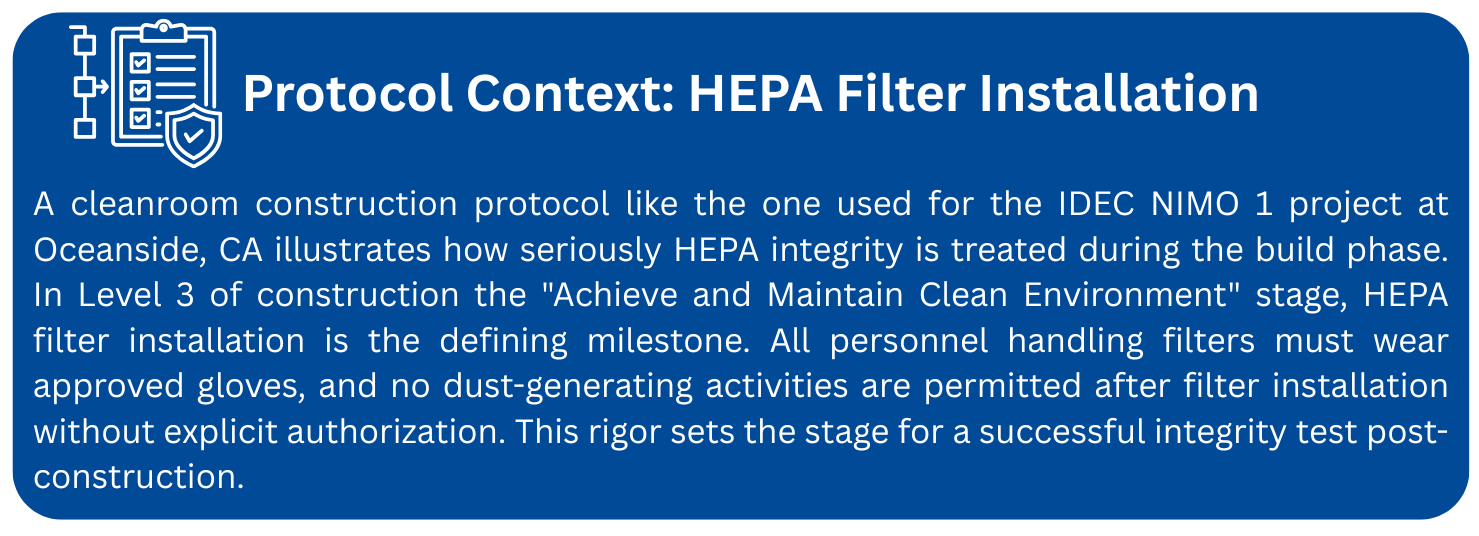
Level 3: Achieve and Maintain Clean Environment
Level 3 is the final and most stringent phase. It begins with mechanical blow-down, followed by HEPA filter installation. From this point forward, the classified area is treated as an active controlled environment, not a construction site.
Requirements include:
- All personnel must wear clean work clothes, hair nets, beard covers, clean coveralls, and shoe covers as posted at each entrance.
- Protective clothing must be removed upon exit and cannot be reused on re-entry without changing.
- All personnel handling HEPA filters must wear approved gloves.
- No dust-generating activities are permitted after HEPA installation without explicit written permission.
- All cleaning materials and agents used in classified areas must be approved; they must be non-reactive and not damage surfaces or finishes.
Where Teams Often Struggle
Most challenges in cleanroom commissioning don't come from a lack of effort. They come from disconnects:
- Design intent vs. real-world performance
- Construction completion vs. operational readiness
- Data collection vs. actionable insight
For example, a room may pass classification at rest but struggle during operation. Or monitoring systems may be installed, but not fully aligned with how the space is actually used. These gaps are where risk tends to live.
What a Fully Commissioned Cleanroom Should Look Like
A fully commissioned cleanroom isn't just compliant. It's predictable.
Air moves the way it should. Pressure cascades hold under real conditions. Environmental data tells a clear, consistent story. Alarms trigger when they should and are trusted by the team.
Operators feel it immediately. There's confidence in the space, and that confidence carries into production, quality, and ultimately patient outcomes.
Where the Right Partner Makes a Difference
Cleanroom commissioning brings together multiple disciplines: airflow, environmental monitoring, system integration, and compliance all need to work together.
That's often where teams benefit from having the right partner involved early and throughout the process.
Rees Scientific supports cleanroom commissioning by helping bridge the gap between design, qualification, and ongoing operation. From airflow verification and environmental monitoring to system validation and alarm integration, the focus is on making sure the cleanroom performs reliably in real use, not just on paper.
Just as important, the same systems and data used during commissioning can carry forward into day-to-day monitoring. That continuity ensures what was qualified is consistently maintained.
For organizations building or scaling cleanroom environments, that consistency can make the transition from project phase to full operation much smoother.
Frequently Asked Questions
What is the difference between cleanroom commissioning and qualification?
Commissioning ensures systems are installed and operating as designed, including HVAC and airflow. Qualification verifies and documents that the cleanroom meets required performance and regulatory standards (IQ/OQ/PQ). Both are essential and closely connected, and both are influenced by what happens during construction.
What is a Clean Build Protocol, and why does it matter?
A Clean Build Protocol is a formal set of procedures governing how construction personnel work in and around classified cleanroom areas. It establishes tiered cleanliness requirements that escalate as the build progresses. Following a structured Clean Build Protocol reduces the risk of introducing contamination during construction that can only be discovered, at significant cost, during commissioning.
How long does cleanroom commissioning typically take?
It depends on the size and complexity of the facility. Smaller clean rooms may take a few weeks, while larger or more complex environments can take several months when testing, adjustments, and documentation are included.
What are the most common issues found during commissioning?
Common issues include airflow inconsistencies, pressure cascade failures, and environmental instability during operation. Smoke studies and dynamic testing often uncover problems that aren't visible during initial setup, and many trace back to decisions made during construction.
When should environmental monitoring be implemented?
Environmental monitoring should be introduced during qualification. This allows teams to establish baseline data, confirm alarm functionality, and ensure the system reflects real operating conditions.
How often does a cleanroom need to be requalified?
Requalification is typically performed annually, but may also be required after facility changes, equipment updates, or process modifications that could impact environmental conditions.
Ready to Take the Next Step?
Planning a new cleanroom or upgrading an existing space? Connect with Rees Scientific to align commissioning, qualification, and ongoing monitoring from the start.