Regulatory Compliance
Your CAP Checklist Just Got Stricter on Humidity. Here’s What That Means for Your Lab
Author: Gagan Kaur
May 15, 2026
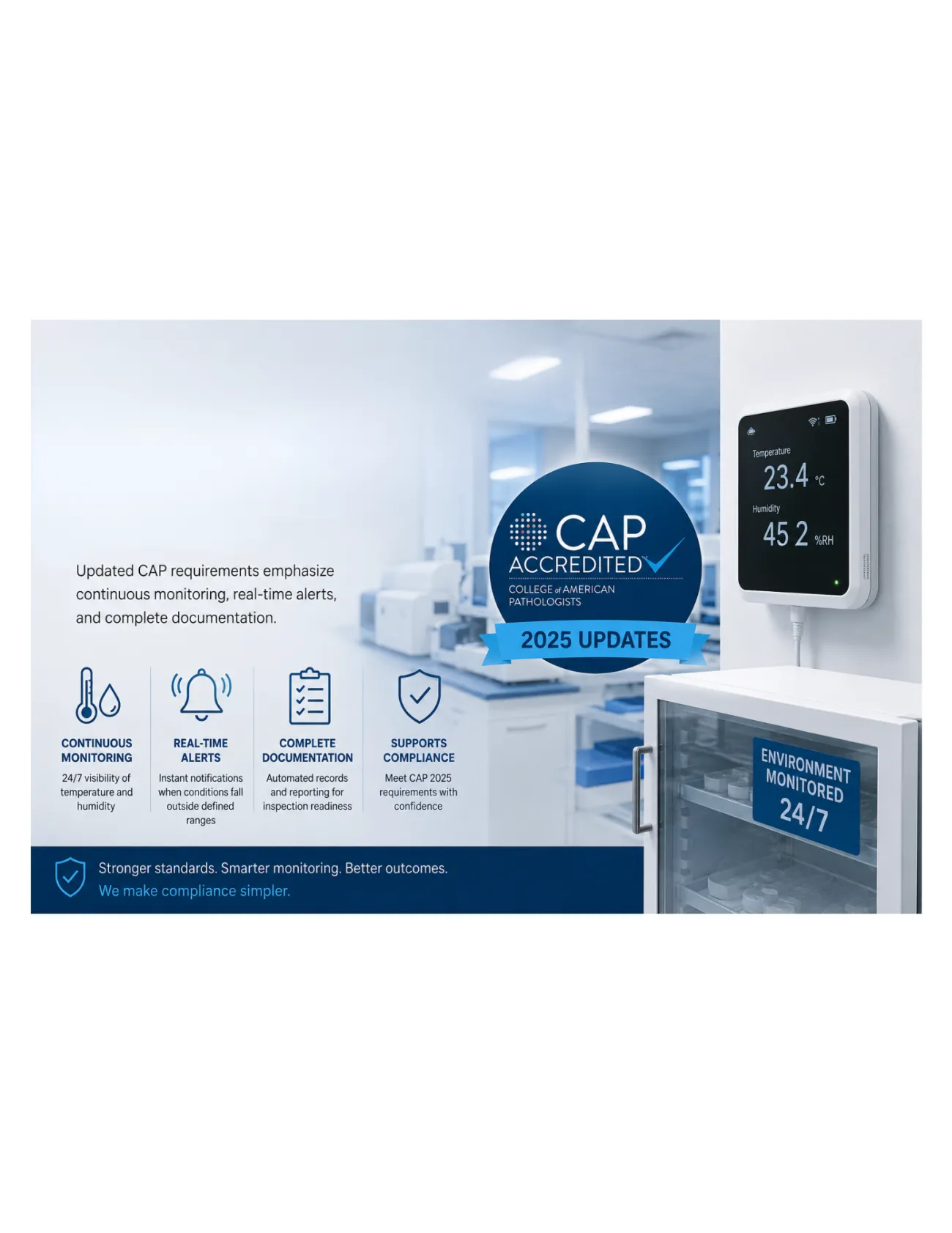
If your laboratory is CAP-accredited, the 2025 checklist update introduces a meaningful shift in how environmental conditions need to be monitored and documented.
Two updates in particular are worth paying attention to: one expands humidity requirements, and the other raises the bar for temperature monitoring. Together, they signal a move toward continuous, documented oversight of your lab environment, not just during working hours, but around the clock.
What Is the CAP 2025 Checklist?
The College of American Pathologists (CAP) is one of the leading laboratory accreditation organizations in the United States. Each year, CAP updates its accreditation checklists to reflect evolving best practices, regulatory expectations, and quality standards for laboratories.
The 2025 CAP checklist introduces updated requirements around environmental monitoring, particularly for temperature and humidity control within laboratory environments. These changes are designed to improve documentation, strengthen quality assurance practices, and help laboratories maintain conditions that support accurate testing and reliable results.
For laboratories seeking or maintaining CAP accreditation, these checklist updates are important because they directly impact how environmental conditions must be monitored, recorded, and managed on a daily basis.
What Changed in the 2025 CAP Checklist
The College of American Pathologists updates its accreditation checklist annually. In 2025, two requirements stand out for their direct impact on day-to-day lab operations. These two updates place greater emphasis on continuous lab humidity monitoring and documented environmental control in accredited laboratory environments.
COM.30580: Humidity Monitoring Is Now Front and Center
Humidity monitoring is no longer a background requirement. It has been elevated to the All Common checklist, which means inspectors across all lab sections are now expected to review it. For many organizations, this marks a significant shift in how lab humidity monitoring is approached and documented.
If a manufacturer specifies a humidity range for an instrument or test system, your lab must:
- Record humidity daily while the system is in use
- Ensure readings stay within the defined range
- Document any corrective actions when excursions occur
This change reflects a growing focus on environmental conditions that directly impact test performance.
COM.30750: Temperature Monitoring Must Cover Off-Hours
Temperature monitoring expectations have also been clarified.
Labs are now required to demonstrate that they know the temperature even when the lab is closed. This means:
- Continuous monitoring devices or min/max thermometers are required
- Manual spot checks during business hours are no longer sufficient for compliance
In practice, this pushes labs toward systems that provide full visibility beyond staffed hours.
Why the Focus on Humidity?
As instruments and reagents become more sensitive, lab humidity monitoring is becoming a more visible part of overall quality assurance.
In many cases, labs were capturing humidity data but not maintaining conditions within the manufacturer-specified range. By moving this requirement into the All Common checklist, CAP is making sure it gets reviewed consistently across all departments.
It also aligns with a broader shift in the industry toward tighter environmental control, especially as instruments and reagents become more sensitive.
Who Needs to Pay Attention
Any laboratory performing regulated testing should evaluate whether current lab humidity monitoring practices align with updated expectations.
That includes most:
- Chemistry analyzers
- Immunoassay systems
- Molecular platforms
- Reagent kits
If your lab also operates under CLIA or AABB, this won’t feel entirely new. The expectations are increasingly aligned across regulatory bodies, all pointing toward continuous monitoring and documentation.
Industries Where These Requirements Matter Most
The updated CAP requirements are especially relevant for industries that rely on tightly controlled laboratory and storage environments to protect sample integrity, testing accuracy, and regulatory compliance.
These industries include:
- Hospitals and Healthcare Laboratories where environmental conditions can directly impact diagnostic testing and patient care
- Blood and Tissue Banks that require continuous monitoring to help protect valuable blood products, tissues, and biologics
- Cleanrooms and Controlled Environments where stable temperature and humidity conditions are critical for maintaining product quality and contamination control
- Pharmaceutical and Biotechnology Facilities operating sensitive instruments, reagents, and research environments
- Research and Academic Laboratories performing regulated or highly sensitive testing procedures
As environmental monitoring expectations continue to evolve, many organizations are moving toward centralized systems that provide continuous visibility, automated alerts, and long-term data retention.
What Inspectors Will Expect to See
Meeting the updated requirements comes down to having complete, reliable records, not just occasional logs.
During an inspection, labs should be prepared to show:
- Continuous monitoring of temperature and humidity, 24/7
- Defined alert thresholds based on manufacturer specifications
- Real-time alerts when conditions fall outside acceptable ranges
- Documented corrective actions tied to each excursion
- At least two years of retained, accessible records
- Calibrated sensors with NIST-traceable documentation
The key shift is from periodic checks to continuous accountability.
The Bigger Picture
This isn’t just about passing your next inspection. It’s part of a larger trend toward data-backed environmental control.
Manual logs and occasional checks leave gaps. Continuous monitoring closes those gaps and provides a clear record of what happened, when it happened, and how it was addressed.
For many labs, that means rethinking how environmental data is captured and managed.
How Rees Scientific Supports CAP Compliance
As requirements evolve, many labs are finding that manual processes and disconnected systems are no longer enough to keep up.
Rees Scientific helps laboratories simplify lab humidity monitoring through centralized environmental monitoring systems designed for continuous oversight and audit readiness. Our system provides 24/7 visibility into temperature and humidity conditions, with automated data collection and real-time alerts when conditions fall outside defined ranges.
Instead of relying on manual logs, labs have access to centralized records that are organized, time-stamped, and ready for inspection. Alerts can be configured based on manufacturer specifications, helping ensure that excursions are identified and addressed quickly, with documentation captured along the way.
In addition to monitoring, ongoing calibration services help maintain sensor accuracy over time, supporting the expectation for NIST-traceable performance.
The goal is simple: make it easier to maintain consistent environmental control and have the documentation to prove it when it matters.
Frequently Asked Questions
Do all labs need to monitor humidity now?
Not necessarily every lab, but if any of your instruments or test systems have manufacturer-specified humidity ranges, then yes, you are required to monitor and document it.
For most modern labs, this applies to at least some equipment.
Is daily humidity logging enough for compliance?
Daily logging is required when systems are in use, but it may not be sufficient on its own.
Inspectors are increasingly looking for consistent control, which often means having continuous monitoring in place to catch excursions that happen between checks.
What qualifies as acceptable temperature monitoring after hours?
You need a method that captures temperature when no one is in the lab.
This can be a continuous monitoring system or a min/max thermometer, as long as it provides a record of conditions during off-hours. Manual checks during the day do not meet this requirement.
How long do we need to keep environmental records?
CAP expects at least two years of records to be retained and readily accessible during an inspection.
Having organized, easy-to-retrieve data can make a significant difference during audits.
What happens if we don’t meet these requirements?
Failure to comply can result in deficiency citations, which may lead to corrective action plans and follow-up inspections.
Beyond compliance, gaps in monitoring can also create risk for test integrity and lab operations.
Are these changes unique to CAP?
No. These updates reflect a broader regulatory trend.
CLIA, AABB, and other standards bodies are moving in the same direction, emphasizing continuous monitoring, proper documentation, and alignment with manufacturer specifications.
Not Sure If Your Lab Is Ready for the 2025 CAP Checklist?
If you’re unsure whether your current monitoring setup meets the updated requirements, it’s worth taking a closer look now rather than during an inspection.
Rees Scientific can review your existing configuration, identify any gaps, and walk through what’s needed to align with the 2025 checklist.
Reach out to schedule a quick review or start the conversation with our team.